Observations and Reflections from a Lifetime Educator
Author: jonsaxton33
A career educator, as a professional with thirty years experience I now work with schools as a consultant specializing in business development for Dynamix Energy Services. My passion has always been as an educator, serving and helping children to be empowered by a quality education. As an advocate for public education, I believe there is hope for our future so long as we place value in doing our best to ensure the institutions are maintained by high expectations, professionalism, and most of all compassion for all.
It’s easy for educational leaders to get caught up in “firefighting” or moving busily from one problem to another without taking time to plan for success, measure progress, and re-direct their efforts when necessary. Be sure to formally establish your guiding principles. If you don’t really know what you’re all about and trying to accomplish you can’t expect anyone else to either.
A couple years into my tenure as a superintendent I realized we had not clearly established the things we wanted our administration to be known for. What was it that would set us apart from other schools or other leadership teams and accomplish what we needed to accomplish? In order to know what we stood for we had to parse through all the things that we were responsible for and trying to accomplish and decide which priorities were most important and would become the focus of our attention.
A real challenge today is the fact that schools are given more responsibility to take care of more things in the lives of children than ever before, but command less respect and authority than at any time before also. Though I could not control the weather, if our students were out for more than a day due to the weather conditions we worried that some children would not have anything to eat. We worked with agencies to try to provide backpack meals for the weekends, fresh fruits and vegetables programs, and summer meals too. The foundation of doing what is best for kids was a constant reminder to our teachers, staff, and administration. What was really neat is when you are focused on something so easy around which to build consensus, it is fun to get folks on board so that we were all swimming in the same direction.
Oftentimes these foundational beliefs can be stated and reiterated in a mission statement or strategic plan, but the key is not just talking the talk, it is walking the walk. Formalizing your foundation by explicitly stating the organization’s priorities is a great way to ensure everyone knows what has been established as most important and to take proper actions through onboarding, professional development, evaluation, and in daily interactions. I am very visual so having a graphic image was a good way for people like me to process and reinforce what our foundational principles were.
Simon Sinek, the famous modern day philosopher and author encourages us to “start with Why” and formalizing your why, and your “how”, helps you accomplish your “what.” In our diagram the pillars were set upon our foundation (our why) and it was those four pillars that became our “how.” In our case the “what” was “Systemic Excellence” which is a whole other topic unto itself, but in a nutshell it was developing a systemic approach to all the things that were part of the school’s responsibilities. The words and ideas conveyed by the words in our graphic were what we collectively believed we needed to focus on at the time. These are by no means a “one size fits all” for all schools at all times.
Have you formalized your foundation? There is no perfect time to start and there is no perfect formula for doing it. While formalizing the beliefs, values, principles, mission, vision etc. will not guarantee success, NOT formally doing so will only help to ensure you are not successful. Remember one does not simply achieve success by chance. Success comes as a result of a deliberate effort over a sustained amount of time!
An Administrator’s Perspective on Restorative Practices
Not long after becoming a superintendent I had two experiences that woke me up to the chilling fact that teachers were no longer safe in their own classrooms. Given the respect that I know was expected for adults in my home, it is hard to fathom how blatantly students could disrespect their teachers, but these two experiences brought to light the danger our teachers face in schools. The first incident involved a principal in one of our elementary buildings who was attacked by one of his students, and the next thing I knew he was in a sling. The second incident involved a student having a “meltdown” in a summer school classroom after he refused to do the work that was assigned to him in class that day. The student cussed out the teacher and literally re-arranged all the furniture in the classroom before police arrived to address the disruption. I knew that the problem was going to get worse if something wasn’t done about this problem and I knew if it was to be taken seriously it had to begin with me, the leader of the district.
I had read about Restorative Practices, but knew that simply allowing a student to correct themselves, especially when dealing with disrespect towards a staff member was simply not enough. Our district had previously gone through the required training with PBIS and we had also received funding to implement SWIS (School Wide Information System) as part of that initial PBIS implementation. While we were trying to enter the data, as was often the case, we got bogged down with entering data and failed to use it appropriately to inform our decision-making. We were doing a pretty good job of actually tracking the numbers, but were not really using the data to implement changes in policy or practice. We were good at “admiring the problem,” but had failed to solve it.
One of the things I knew NOT to do was give my idea a name. If you ever want to kill a good idea give it a name and roll it out as a new “initiative.” Teachers hate initiatives. In fact, they don’t care much for the terms program or system either. Because we have been conditioned to be cynical about any kind of change in school, it is really important to introduce it carefully to the staff. Even though in many cases teachers want changes, their idea of change, and yours may not be the same thing. I knew our teachers wanted to be made to feel safe. So at the same time I was doing my “Restorative Practices” experiment, we were also introducing a “Respect” campaign and a couple years later we ran everyone back through the PBIS training (required by Ohio law) again.
While our Respect “Campaign” could be considered an “initiative” it’s pretty hard to argue with the emphasis we were placing on showing respect. We created a logo, printed posters and t-shirts, we had conversations in all of our buildings about our operational practices and what “Respect” looked like and sounded like for students, staff, parents, and our community. We had experienced a great deal of success with our district-wide The Leader in Me Program and our Respect campaign was intended to be reinforcement of the cultural changes we had been successfully making in the district for several years.
You’re probably wondering, what exactly was your Restorative Practice? As I mentioned I wanted our faculty and staff to feel safe in their classrooms and starting with those two previously mentioned situations I had observed far too many incidents of students cursing at teachers, threatening teachers and in some cases assaulting teachers. In our Code of Conduct these things were major violations and would result in a mandatory suspension from school. While there has been increasing pressure to reduce suspensions as a result of state testing, local report cards, learning loss, and inequities in suspension occurrences in at-risk subgroups, to eliminate the suspensions altogether would have resulted in a mutiny and there was a risk that doing anything that seemed more lenient would lead to an increase in these student violations which was simply not acceptable. Leniency wasn’t the answer, but doing nothing different would not solve the problem either. Something had to be done. The message needed to remain clear: Students are expected to respect adults at all times in our schools.
My plan was fairly simple: Students who swore at, threatened, or assaulted a staff member would be suspended for a minimum of five days from school AND in order to return to school their parents WERE REQUIRED to meet with me, the Superintendent. The purpose of the meeting was not to appeal the suspension, rehash any of the facts regarding the student’s behavior, or place blame on the teacher, school or administrator regarding the behavior or the events leading up to the incident. The purpose of the meeting was four-fold: 1) Get the parents and administrators working together in the best interest of the student, 2) Reinforce the responsibilities of the student, parents, and the administrators to protect the safety of the teachers, 3) Do everything possible to ensure the behavior does not re-occur, and 4) Provide the parents and the student with the resources necessary to get whatever help is needed.
In my experience some parents are convinced that either the teacher or the principal is out to get them. Believe it or not, students who act out regularly place blame on others for their behavior, and too often, for one reason or another, parents often defend their child’s behavior. With the growing use of social media for parents to criticize school officials, respect for teachers and principals is at an all-time low and often people will take to social media to threaten the job security of teachers and principals and enlist the support of others to undermine the decision of school leaders. As a superintendent, I did not interact with many students on a daily basis so I found that I often had more leverage as an educator because I did not interact regularly with the student so parents usually did not have reason to think I had “it in” for their child, which of course I did not. That credibility was extremely helpful in ensuring that the meeting with the parents went well. I also found that when my assistant called to schedule the meeting, because I was superintendent, the parents were willing to meet with me. In two years, I only had one parent who would not meet with me in person. The use of my formidable position, not me the person, was helpful in getting the cooperation of parents. This is a big reason why I think this was a powerful strategy.
It was very important to set the proper tone for the meeting with the parents. Showing them respect, making them feel valued, patiently listening, and outlining the purpose and procedures of the meeting was really important. In every case the parents were cooperative with me. They understood why they were there and I think appreciated the fact that I was actually trying to help them as parents by speaking with their children about their inappropriate behavior. In some cases they were at their wit’s end trying to deal with the behavior in their homes too. Some were relieved that I was there to help and I’d like to think I showed them I was genuinely concerned for their son or daughter (because I was) and I wanted to get their child’s behavior back on track. Some times we discussed resources such as social workers, doctors, medication and other strategies that might be helpful, and I took as much time as was needed for the meeting.
One time I remember meeting with a family and let’s just say the parents were not being considered for “parents of the year.” In some cases it’s no wonder some of our students have behavior problems due to the manner in which they are being raised. That does not give me a right to be judgmental and critical, besides I cannot control what they do in their home anyway. After a few minutes of our meeting, I asked the student what his plans were for the rest of the day were, which was only his third day of suspension. Without flinching he said was going to “go home and play video games.” I was frustrated that the parents did not even pretend to be bothered by his statement or correct him. Of course, this is why this student was in my office to begin with. In my mind I thought “Oh no you’re not!” I instinctively reacted and politely explained to his parents that his suspension was over and contacted his teacher. We secured a chromebook (contained all he needed for class that day) for the student and I personally walked him to the class he was scheduled for at that time and discussed the reason for my appearance with his teacher. This was an excellent teacher and I think she understood the situation well. The farther behind the student was the more likely he would be to misbehave or miss even more school. It was more important in that case for the student to be back in school than it was to serve two more days of suspension playing video games.
I kept track of these meetings and followed up by communicating with the building’s principals. Oftentimes they were invited to the meetings with me, but unlike an expulsion hearing I usually was able to meet with the parents and students without the principals because our principals were already very busy. In the two years I adopted this Restorative Practice I met with more than 100 students and their parents. As I mentioned there was only one parent who refused to meet in my office and there were less than a handful of students who swore at, threatened or assaulted our staff who repeated their inappropriate behavior.
This practice did not completely prevent the disrespect from occurring, but there is no magic bullet for preventing any particular type of behavior. It was enlightening for me and along with PBIS, our Respect Campaign, and our use of software that would help us identify vulnerable times, locations, and practices we were making a concerted effort to ensure that our staff and students felt safe at school. There is no “one size fits all” strategy that will serve as a panacea for addressing these unwanted behaviors. A mentor of mine reminded me that I wasn’t a super-principal, I was a superintendent, and that dealing with these types of things were not something I should concern myself with, but for me, I felt that spending my time staying in touch with these types of issues and supporting my staff was important. Often times administrators and teachers do not connect enough with parents for a variety or reasons. I think the educators get too busy, or assume parents won’t support them, but I found the parents to be very supportive and it was a great opportunity for me to connect with them and help them and their children. I found the activity to be well worth the time and making those connections with parents is definitely worth the investment of time.
No program, initiative, or system can substitute for the investment of time, understanding, compassion, respect, empathy, and genuine concern. As a superintendent if we can model and lead these efforts in our districts a lot of things will eventually fall into place and a safe environment will be created in which teachers can effectively teach, and students will learn.
Today we parked our car in the front yard of the location where the old Logan Elm High School building used to stand. It is now nothing more than a pile of rubble. In 1960 it was a state of the art building with lively colors and patterns adorning the floors and walls. It was built for an enrollment of about 300 students and it replaced several older township schools which were built just before and after World War I. Although those township buildings were 45 years old, the district had grown, the world had changed and those old buildings were no longer suited to best providing high schoolers with the facilities needed to deliver instruction. Those township schools had replaced previous schools that had been outgrown as well.
The last new building built in the Logan Elm School district is the George D. McDowell Exchange School completed in 1971. It’s been 52 years since students in the Logan Elm community have had any new schools and 63 years since Logan Elm High School was built. To accommodate growing enrollment modular buildings were added at every LE campus except Pickaway Elementary.
I attended my junior and senior years at Logan Elm High School and enjoyed my time in this quaint little school amidst the cornfields of the Pickaway Plains built 25 years before I graduated. When I attended the school I didn’t notice that it was out of date, I didn’t really notice that it wasn’t air conditioned, and I didn’t notice how undersized the building was for the amount of students enrolled. I did begin to notice those things when I was a teacher there beginning in 1989. I really began noticing some of the deficiencies when my children attended school in elementary buildings that were 100 years old, a middle school that was impossible to secure, and a high school that was badly lacking in space, safety, and the facilities needed to educate children in the 21st century. In particular I noticed the buildings were not adequate for students with disabilities because of the lack of proper spaces and accessibility for those with handicaps who are entitled to the least-restricted environment.
When my wife and I toured the old LEHS in the spring of this year we couldn’t believe how awful and outdated that facility was. The hallways were narrow and poorly lit, the cafeteria was undersized, the bleachers in the gym were a death trap, and the heating, ventilation, and lack of air conditioning were deplorable. I was mad at myself for not having done more as a teacher and parent to advocate for the children and staff who attended our school. In our community the location has been such a divisive issue. Since the consolidation of the Laurelville School in 1972 there has been some bad blood about students from Hocking County being forced to attend the school in eastern Pickaway County when the Laurelville School was forced to close. In many cases residents from Hocking County have felt slighted and unfortunately those wounds have been slow to heal for some people. I wish it weren’t that way and am hopeful those wounds will heal. It will be a new experience for elementary children to ride buses to the school on Tarlton Road instead of in downtown Laurelville, but it is just not feasible for the district to maintain multiple campuses and after several failed attempts, the majority of Logan Elm’s voters finally said “It’s Our Time.”
Now, 63 years after the old high school was completed and 52 years after McDowell opened, Logan Elm kids get to go to a new school that is adequate for their needs. It is so long overdue.
I once had to make a recommendation to a board of education to tear down an old building. The building had been closed before I worked in the district and during the 8 years or so it sat vacant without a plan for its future it deteriorated significantly. The state was not going to give us any funding to renovate that school, yet there were community members who were up in arms angry with me for recommending the building’s abatement and demolition in order to secure 55% of the funding from the state to build two new elementary buildings. Additionally, we were able to do so by leveraging funds that were already being collected from a previously passed operating levy and the result was the community received two new elementary buildings without raising their taxes on campuses that were within a few blocks of one another. Although I attended the old school which was torn down, I too knew that it didn’t meet the needs or access for children in elementary grades in 2015. Knowing that the state refused to give us any assistance it really became a fairly easy, although painful decision. My job was to do what’s best for kids and provide them with the best education possible. I knew how to do that and we were fortunate the majority of voters agreed.
Those lamenting the demolition of the old building cited it as historic. Although it was 80 years old it was not historic. This building was not our community’s high school, it was our community’s building. The high school lived on. Although we can tear down buildings, we don’t tear down schools. The schools, and their memories live on in the hearts and minds of those who attended and worked there. When that 80 year old building came down, my memories of it did not go away. I still have them although that building was torn down more than seven years ago.
As I walked by that pile of rubble today on Tarlton Road, I came to the realization that Logan Elm High School wasn’t gone. The memories of attending class and teaching students in that building will live on for the rest of my life with me, and it will live on in the hearts of my students and my children too. Those memories are also preserved in the pictures and yearbooks and stories that we will tell, but the school, it’s better than ever and is located just a few feet west of the old building.
Visting the new school I saw staff who were so excited about having the opportunity to teach students tomorrow. They were proud of their school building for sure. The building is absolutely breath-taking, but the school, well that’s another story. I saw the school in the eyes of the more than a dozen of my former students who are now teachers and principals there. Logan Elm HS and all the other buildings are memorialized on the walls and in the design of the structure. The school is alive and well. You see, the “school” isn’t a building. It’s people. It’s a culture, tradition, a set of values, the teaching and learning and care for our most valuable asset, our children. Now our kids have the building they need to keep them safe, to help them learn, to ensure their well-being, health and development, but that building doesn’t do that by itself. The people do those things and the people of Logan Elm finally have the school their children deserve and I was happy to walk through it on August 27, 2023.
Our church decided to disaffiliate from the United Methodist Church this past week. I spent my whole life as United Methodist parishioner. I have good memories of growing up in Trinity United Methodist Church, moving to our farm and attending Kingston United Methodist Church, getting married and attending Bainbridge United Methodist Church, and spending the last 30 years as a member and leader of Salem United Methodist Church. Though I’m not likely to be a United Methodist anymore, what has struck me today really doesn’t have anything to do with the UMC, it has to do with the fact that I was taught that Jesus Loves Me in that church from a very young age.
What concerns me at this point in my life isn’t what I was taught or not taught in the church, but what future generations of children are being taught. Our Pastor chose “Jesus Loves Me” as one of our songs for worship today.
1 Jesus loves me, this I know, for the Bible tells me so. Little ones to him belong; they are weak, but he is strong.
Refrain: Yes, Jesus loves me! Yes, Jesus loves me! Yes, Jesus loves me! The Bible tells me so.
2 Jesus loves me he who died heaven’s gate to open wide. He will wash away my sin, let his little child come in. [Refrain]
3 Jesus loves me, this I know, as he loved so long ago, taking children on his knee, saying, “Let them come to me.” [Refrain]
You might be thinking our congregation might be a “little old” for “Jesus Loves Me.” Before singing, the Pastor told us we were going to sing it a little slower. I knew that also meant to better consider the words than we might normally do. And so I did.
There are two things that really hit me: 1) Jesus really does love me…and you…and everyone. Jesus loves us whether we are black, white or some other color. He loves us whether we are a saint or a sinner, and there are a lot more sinners than saints. Jesus loves me whether I am Democrat or Republican, whether I watch FoxNews, CNN, or no news at all. He loves me whether I am straight or gay, celibate or not. He loves me no matter what team I root for, what clothes I wear, how I smell, what I drink etc. You get the point. Jesus even loves Buddhists, Hindus, Muslims and atheists. He loves everyone – On this 3:16 Day we are reminded that He made the whole world and loves us so much that He died on the cross for our sins so that we will not perish, but have everlasting life. All of us.
The second thing that really hit me was 2) Do our children even learn “Jesus Loves Me” anymore? With so few families in church these days, are our children even learning the very basic beliefs of the faith? Is our society becoming so hateful and divided today because children aren’t learning the very basic things that many of us were taught in church and Sunday school? and what can I do about any of this? are just a few of the questions I asked myself as I sat in church feeling a bit inadequate to do anything about this.
As my Dad coached me, I remember him talking about the basics. I learned the importance of the word “fundamentals” from a very young age. As a coach myself I think that may be the one thing I did well. My point is that we must teach our children that they are loved from a very young age [that is a must]. My personal viewpoint is that they are loved by God and that Jesus is part of the Holy Trinity and the Godhead loves us all. The basics of John 3:16, the Apostles’ Creed, the Lord’s Prayer and Jesus Loves me should be taught in our Christian homes. The fact that it is probably not is on display in America’s Schools, in our secular society, and on social media. I don’t say this in judgement, I say this in observation, wanting to help solve the problem and feeling a bit helpless to do so.
Many Americans continue to “identify” as Christians, though it seems as though we don’t always behave that way. Church attendance is down and we are continually bombarded by judgement and hate, even sometimes from people in the church. To quote Walt Whitman: What good amid these? Answer: That life exists and identity. That the powerful play goes on and you may contribute a verse. My verse for today: Jesus Loves Me (and you) and so do I.
Sometimes being a school leader can be a Dirty Job
Mike Rowe hosted a show a few years ago called “Dirty Jobs.” As part of the show Mike performed some of the most difficult, strange, disgusting and messy occupational duties alongside typical workers, also known as “thankless jobs.” I think the reason for this show was so that we would better appreciate some of the jobs that people have to do so that we can enjoy the conveniences of the lives we live. I know my eyes were opened by more than one episode of this show and I hope that I gained a better appreciation for the work done by people I took for granted. Though it never aired on Dirty Jobs, I think the job of school superintendent may be one of those under-appreciated jobs and I wanted to take a moment to offer a shout out to the hard-working, highly-educated professionals who are on the frontlines of the war against the Coronavirus.
Please know that this post does not discount the hard work and the underappreciated efforts of other educators and educational support staff workers. As a school board member, former superintendent, principal, and teacher I know and understand all the jobs and roles people working in the school play and how important each and every one of those jobs are to the well-being of students and I appreciate all that they do, but rarely do we ever give credit to superintendents. Now that I no longer serve as one I think I can offer up my “shout out” to those with whom I served alongside for ten years for all their hard work and the dirty jobs they have to perform.
While the working conditions do not usually involve masks, gloves, sludge, nasty substances, heat, cold, heights or tight spaces, the job of a superintendent, especially if done right, is very difficult. There are no “easy” days and there was never a day when I came home feeling as though I “won.” There were some days when I felt like I didn’t lose as bad as others, but almost every day brought a new challenge and no matter what I decided it seemed someone was upset with my decision. Sometimes I would get beaten up in the newspaper, sometimes on social media, and occasionally on the phone or in a meeting, and in all cases I had to remain professional at all times and avoid reacting or retaliating against anyone. A superintendent cannot have a “bad day” for he or she will be judged by something as simple as their posture. It’s just a really hard job.
Some will say that’s why superintendents earn the “big bucks” but I think there are very few CEOs of privately owned companies who would want the responsibilities that come with being a superintendent for the pay that superintendents earn. Good superintendents are typically on-site between 55-65 hours per week and must respond to email and calls at all hours of the day and night. In my ten years as a superintendent or assistant superintendent my phone was never “off” even while on vacation.
Many of us who became superintendents did so because we wanted to have a bigger impact on our school and in the lives of our students. We were not lured by the promise of big money because for the hours and the work it simply wasn’t. In my case, though not aspiring to become an administrator, I felt as though I had received a “call” and that it was a moral imperative to fulfill the role of an administrator using my energy, experience, and expertise as an educator. I loved leading other educators and working hard in the best interest of my students. I know my superintendent friends feel the same way and I continue to be impressed by many of the superintendents I know who work tirelessly to do what is best for kids. They don’t punch a clock or get overtime, and often what they have to do is not appreciated or recognized. Many times it isn’t even known.
As these men and women make decisions about 2020-2021 school year, please remember they are doing the best they humanly can. They are working with sets of facts which change regularly, if not daily, and at the end of the day are always trying to do what they believe to be best for kids. Though I don’t look for Mike Rowe to be airing an episode on their work, it really is a tough job and these folks are deserving of our appreciation. Thank you school superintendents!
In the days when some of the best leaders are applauded for their use of building teams, collective decision-making, empowering subordinates, and delegating their authority, there tends to be a dim view of the idea of control. It’s as though the idea of a strong leader having control is a bad thing. In this post I want to share the idea of when “control” isn’t a bad word for school leaders.
Admittedly, my title is a bit misleading. I have intentionally phrased the topic of this post to get your attention. Having served in a leadership position for many years, I know there are those who are critical of leaders who act firmly and decisively. It is my belief that as important as delegating and empowering others is, there are times when the leader must be decisive and when that happens, these leaders are often criticized.
One thing is for sure, in any organization, regardless of who is “in control”, there is tremendous value in order, structure, and efficiency. This is not only true for the Org Chart, but it is especially true for a school district’s Operational System. In my time in the Energy Services business I have learned a lot of things that I did not realize when I was serving as a school superintendent, most of which has been on the operations side of school leadership. I have also learned that many educational leaders do not understand the function and the value of “controls.”
Controls are the “brains” that effectively operate the components of a building’s HVAC system. Today’s controls are essentially the computer that tells the components what to do. Components include sensor, thermostats, boilers, chillers, VAV (Variable Air Volume) boxes, Air Handling Units, Pumps, and VFD (Variable Frequence Drives). These controls have a front-end which is displayed on a computer device and can be accessed on the internet if their technology so allows. There are many types of systems and a school can choose from systems which are proprietary, or open-sourced. Open-source types of systems allow the owner to purchase parts, technology components, and service from a variety of vendors, while proprietary systems can usually only be serviced and parts can only be obtained from authorized dealers and service representatives. While it is important to operate and maintain efficient boilers, chillers, and air handling units, if the control system is not effective the system will not be efficient.
There are three purposes for a controls system: 1) control air movement 2) regulate air temperature and 3) condition the air. The key to maintaining good control is to ensure that the components are effectively communicating with one another to maintain these three items. If there are lapses in communication or components that do not work properly the systems can still operate, but typically do not do so efficiently. When that happens occupants of spaces may experience discomfort due to temperature and humidity, or other conditions in which the air quality is poor. In the case of schools, this can negatively impact learning conditions for students. For example, if a space is not properly ventilated, the space could see a rise in the levels of carbon dioxide. The standard level for a classroom is 1,000 ppm (parts per million). If a classroom is not receiving enough fresh air, those levels have been known to be 2-3 times that amount which makes it very difficult for students to concentrate and stay awake. These levels can easily be monitored with devices known as data-loggers.
Besides temperature and air quality, school leaders can also monitor their systems’ costs which include utility costs and maintenance/repair costs. If these costs tend to rise or spike this could indicate a problem with the controls. This is why it is important to monitor these costs. In Ohio, there are a number of agencies who offer this monitoring and analysis for school districts. META Solutions has an expert with technological assistance and many years experience in the energy industry to assist school districts ensure efficiency. The small investment in this service can pay big dividends to districts who desire to operate efficiently.
In many communities folks have a tendency to believe that the new schools that were built around the turn of the century are still “new.” The fact is that the systems within these schools that are now beginning to experience “end of life” issues and are no longer functioning effectively or efficiently. ASHRAE (American Society of Heating, Refrigerating and Air-Conditioning Engineers), founded in 1894, has developed standards for the life-expectancy of equipment and controls. Though a building may seem relatively new on the outside, the median life-expectancy of many of its components is between ten and twenty years. In the case of electronic Controls the median life-expectancy is fifteen (15) years. Like a Personal Computer, after a few years the controls will not be as responsive, quick, or effective. Most of us would not assume that a fifteen year old computer will help us do our work as well as a brand new one. Likewise, we should not assume a fifteen year old controls system will help us manage our buildings as well as a new one.
As a former superintendent I now realize I didn’t “get it.” At least not all of it. Though our district accomplished a lot when it came to facilities, there was plenty of meat left on that bone! Visiting with schools today I also realize there isn’t a lot of readily available information for school leaders when it comes to operations. As a valued partner, my company and I are willing and able to provide our customers with resources and information that will enable them to maintain proper control of their operations and maintenance expenses.
Though we should absolutely be empowering members of our teams to make decisions to better serve our students, ultimately “control” is not a dirty word. Take effective “control” of your system by making decisions aimed at increasing the effectiveness of your HVAC equipment to save on district operating expenses allowing educators to have the resources in their classrooms instead of spending it in the boiler room.
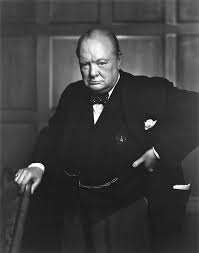
This picture of Winston Churchill hangs in my office. I have the same image for wallpaper on my phone. It’s not because I think Winston Churchill is glamorous. It isn’t because I idolize or worship him. He was a flawed human same as we are. He was fallible. He made mistakes. He ate poorly and drank and smoked too much. He wasn’t even all that likable to many, but few would ever question his dedication to the causes he esteemed. He was defeated time after time, and yet he kept getting back up.
Maybe that’s why I am such a fan of Lincoln too.
Without a doubt my favorite U.S. President is Abraham Lincoln. Again, he was certainly not glamorous. We know he did not receive a formal education, yet he valued education a great deal. He believed in peace and freedom, but he knew if peace and freedom were to be preserved there would be a fight. And he wasn’t afraid to lead it.
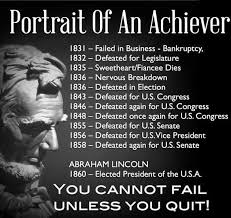
In both the case of Churchill and Lincoln you have people who were willing to stand up for what they believed in and were not appreciated for their noble causes and their incredible leadership. They struggled to form coalitions and faced tremendous opposition. In the case of Lincoln, it ultimately cost his life.
In recent days, actually months, I mean years, I have encountered a few people who have considered giving up. Admittedly, the thought has crossed my mind a few times also. In a recent conversation with one of those folks, whom I love very much, I explained “Why we can’t give up.” Listening to myself it made so much sense I realized I needed to capture those thoughts. Perhaps even sharing them will help others who may be feeling the same way. With social media I can often see others who are struggling with loss and sorrow. A lot of times we don’t know what to say to these people. Well-meaning friends of mine have said “this too shall pass” which doesn’t offer as much comfort to me as I think it does for them who say it. Like me, these good people are trying to understand why such bad things have happened to them – a question not easily addressed or answered in a blog post.
The reason we can’t give up is simple: If we give up we will be miserable for the rest of our lives. We might tell ourselves it doesn’t do any good to keep fighting. It’s just going to end in more heartache. The fact is, no matter what we’re facing, we can overcome. Now it might not be in the way that we want, it may not be our vision of success, but one thing is for sure, if we quit, we lose.
If you are a person of Faith, you believe in an afterlife. As Christians, we believe in an eternal life in which our earthly bodies will no longer fail us, but we will live an eternal life of peace and happiness with God. There’s no way our mortal minds can comprehend exactly just how this works – that’s why we call ourselves people of Faith. We believe our God, who formed the world and all that is in it, is omniscient and omnipotent – He knows everything and can do anything. We take it on Faith that we will one day be not only restored, but made completely whole for an eternity. If we give up we deny eternity, we deny God his proper place in creation and I believe we will ultimately deny ourselves anything to do with God or a heavenly eternity.
And though I strongly recommend being or becoming a person of Faith, those whose beliefs are only temporal (for this world) may also benefit from my reasoning for never giving up. Simply put, if we give up can we even begin to expect things to get better? If we’ve been beaten down, if we’re sick, if we’re hurt, do we think that we will magically get better by giving up? Of course not. That makes no sense at all.
The fact is that nobody ever told any of us this life would be easy. “Bad people” (whoever that means) aren’t the only ones who get sick, lose their jobs, lose a loved one, declare bankruptcy, or fail. Loss, setbacks, failure, and death comes to us all. Sure some of us experience more or less of it than others, but nobody gets out of here alive. No one ever won anything by giving up. Not in the history of careers, sports, politics, or life. Not one person. Ever.
Within just a few weeks of his death, Jim Valvano gave an incredible speech at the 1993 ESPN Espy Awards. As he closed his speech, though well aware of his prognosis, Valvano told the audience he looked forward to being able to present the 1994 Arthur Ashe Award Winner with the award he had just been presented. His 11-minute speech is still impactful to this day, nearly 30 years later. While Jimmy V. knew his life was nearing the end, he used the opportunity to give that speech to inspire millions of people around the world who were battling their own form of cancer. He used his platform to create a foundation which has since raised hundreds of millions of dollars for research and prevention programs because he wasn’t giving up – not until his very last breath.
I have a story to tell. I have value to add. I have a purpose in my life.
By Jon C. Saxton, Former Ohio School Superintendent and current FMX Affiliate
FMX is a versatile, easy-to-use, affordable CMMS tool
Having the tools to do the job well is the key to performing high-quality work. Why is it sometimes school leaders are reluctant to try new things and risk the use of a tool not bringing about desired results? Sometimes it’s simply fear, sometimes it is cost, sometimes it is simply not trusting their own leadership skills enough to ensure something works.
Rest assured school leaders, FMX is an excellent CMMS tool (Computerized Management and Maintenance Software). Of all the software systems I purchased or was forced to use in my ten years as a school superintendent, FMX was the most effective, easiest to use, and delivered the most value!
I like to be organized. I like knowing where things are and having a system for how I organize my files, complete my tasks, remind myself of things I need to do, and deliver on big projects. While delegating is an important skill for school leaders, there are certain times when the leader must be the lead learner and model the use of new ways of doing things. Too often superintendents are pulled away from their focus on being the instructional leader in their district to deal with the latest crisis, a situation that someone did not follow through with, or a management task that distracts them from their role as the instructional leader.
FMX can help! To effectively lead, one must ensure that they have first effectively managed. Sometimes that means putting the right people in the right seats on the bus, and sometimes that means making sure you’re on the right bus. A good CMMS tool creates a “system” for your “system.” Such systems reduce time spent on menial tasks, increase efficiency, and improve communication, collaboration, and coordination of the system’s various resources.
Do you have a system for your system?
Several years ago I found myself as a new superintendent trying to make sure I could be all the places I had to be, know all the things I was supposed to know, and do all the things I was supposed to do. My calendars had calendars. I had one on my desk, one on the wall, one in my pocket, another on my phone/computer, and my secretary had one. All those calendars, all those attempts to stay on top of things and I was drowning in things to remember and do and places to be. And then FMX came along. I don’t think the Sales Representative had finished his presentation when I decided this was THE system OUR system needed.
Steps for Success
Involve representatives of your team in making the decision – Build consensus among leaders of your team guiding them towards choosing a product that will help make everyone’s job easier, the district more efficient, and to improve communication, coordination and collaboration.
Provide Information, Resources, and Support – Materials/resources are available from your FMX sales or customer success representative to be shared with your staff. These materials do not cost anything and your endorsement of this system will help it launch successfully. You’re providing a tool to people to help their jobs become more manageable. Training and online support are readily available – take advantage of it. That’s why we offer it!
Own It! – As a Superintendent this is a tool that can help you to look good and there is nothing wrong with that! You’re likely to be more criticized for being indecisive than you are decisive. Commit to FMX as your OS and be consistent in its use.
Stay the Course – Don’t make exceptions for who has to use FMX. Everyone has to use it, including you as the leader. By embracing it and modeling its use you will help your organization realize “this is how we are expected to do things here.”
Continuously Improve – Look for ways to help your team use FMX better. Your dedicated customer success manager will help ensure you are getting the help you need for your school district, but there are also ways you can develop custom modules for other workflows. This idea of constantly striving to perform better will spread throughout your school district and that can benefit your system in other ways.
Don’t be afraid to ask for help – Your success is our success so if you’re not happy we’re not happy. Allow us to provide you with the help you need in order to help FMX be successful. We’re not going to charge you each time we answer the phone and our goal is to help make your jobs easier so that you will recommend FMX to others.
Conclusion
Spend your time where you can have the greatest impact on student-learning, that’s where your students need you most! Effectively implemented, FMX can help you, your principals and other school-leaders spend less time and energy on things that distract you from the leadership your schools need. This tool is mobile-friendly, secure, and green. It does not rely on paper, and can go where you go unlike the dreaded inbox on the corner of your desk. Please know if I can ever be of help in making your decision or implementing FMX I’m willing and able to help you.
Jon Saxton served as a school administrator for 20 years in central and southeastern Ohio including ten years as a Superintendent. Saxton is a former President of the Coalition of Rural and Appalachian Schools and was an active member of BASA. He currently represents Dynamix Energy Services as a Business Development Representative and is an affiliate for FMX. You may contact Jon at jsaxton@dynamix-ltd.com or by phone at 740-804-4273.
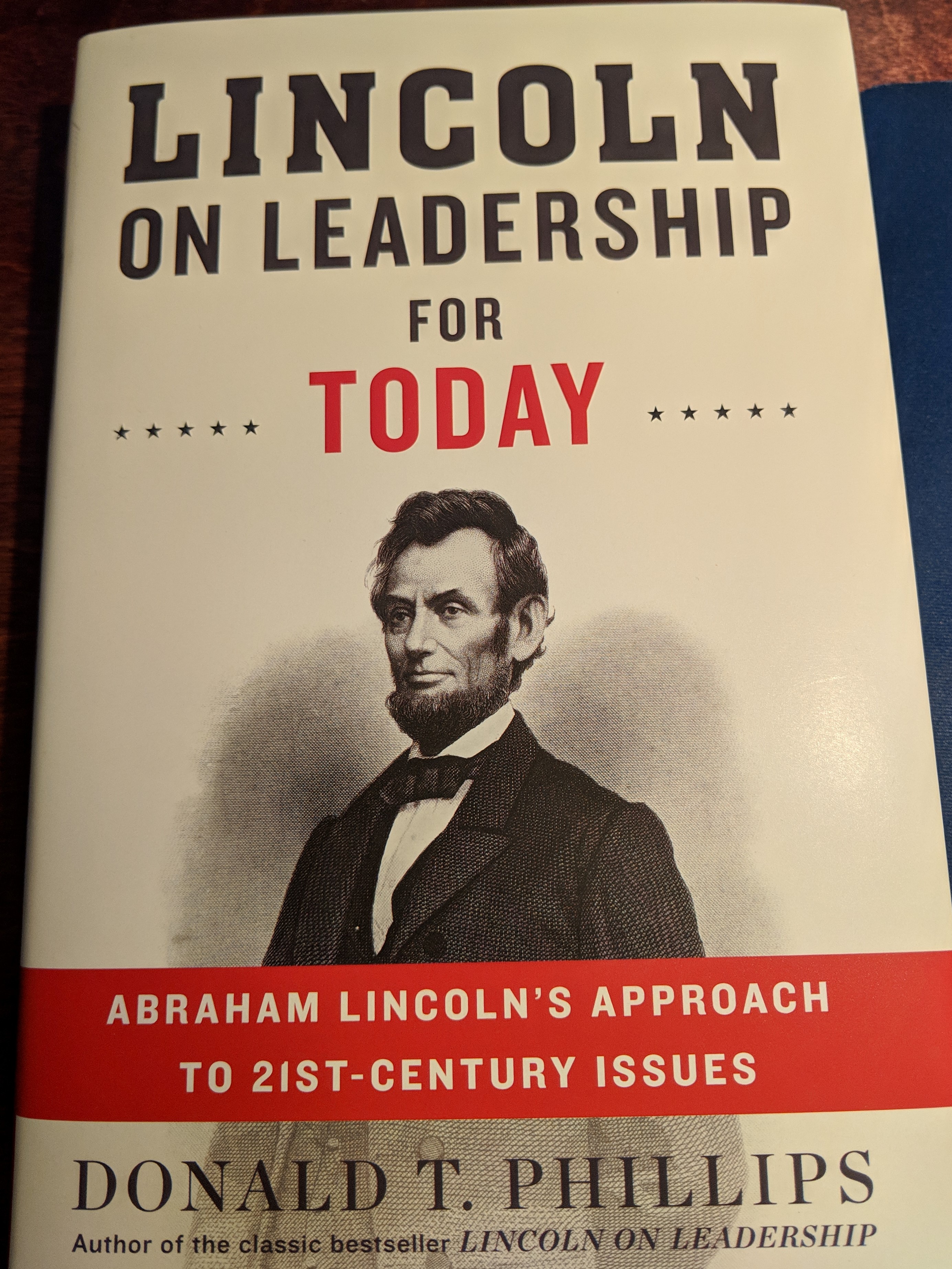
I came across an earlier title similar to this book probably close to twenty years ago and read it with great zeal. The main idea here is that Lincoln’s leadership is timeless. Whether it was the title Lincoln on Leadership I read twenty years ago, or the 2017 edition, Lincoln’s leadership cannot be confined to a single epoch. Rather, the timeless leadership principles Lincoln modeled for his contemporaries or their progeny is incomparable.
Why do we think of Lincoln as such a great leader? Perhaps one of the reasons is because he led in such a challenging time. One of my favorite JFK speeches was delivered at Rice University in September of 1962 and he was discussing the space race and established the goal of sending a man to the moon before the end of the decade. Kennedy pointed out that we choose to do these things not because they are easy, but because they are hard. Lincoln’s lofty goals for peace and preserving the freedom of all men regardless of their skin color, was the hard thing to do 100 years prior. There is little glory or sense of accomplishment in doing things which are easy. That’s why a shot from 23′ counts as 3 points and a layup is only 2 and a free throw with everyone standing still while the shooter shoots is only worth 1 point. We value things which are hard, and nobody had a harder job as President than Lincoln.
Over the past few days I have reviewed several books from Learning from Lincoln, to Lincoln’s Melancholy, another on his Team of Rivals cabinet, and another regarding Leadership in Turbulent Times all of which are excellent books from which to approach different facets of Lincoln’s leadership. But on the eve of Lincoln’s birthday Donald T. Phillips Lincoln on Leadership stands above these others as a guide for how to lead like Lincoln. It should be required reading for CEO’s, school leaders, and elected officials.
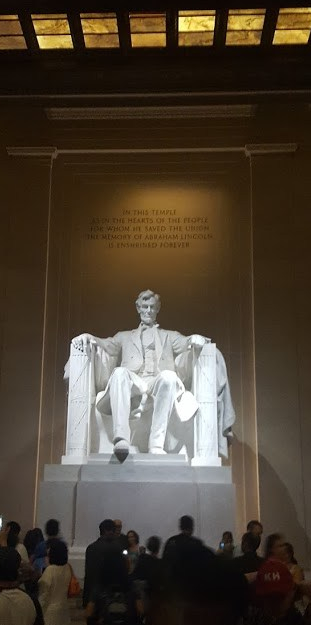
The Gettysburg Address does not appear behind the seated President as this photo represents.
The Gettysburg Address
Of the many things I would do differently if I were still in the classroom today, one would have been to have spent more time teaching about The Gettysburg Address as a piece of historical literature. The curriculum I taught, or perhaps the lack thereof did not require me to do more to teach the Gettysburg Address. Sure I read it aloud or assigned it as reading. I am also quite sure that I couched the address in between dates and battles and the things that were taking place in November 1863. I may have even compared the happenings of that November with the fateful events of November 1963. But I don’t think I helped my students truly understand the magnanimity of this famous speech as I should, or would if ever given the chance to be in the classroom again.
What I’m not sure I did was teach my students about the beauty and eloquence of the speech, not simply the choice of words but of the thoughts, and purity of heart of our greatest leader. I’m not sure they were able to grasp the power of Lincoln’s words. I haven’t been in the classroom as a teacher in twenty years, but this would not be the only thing I would do differently. I don’t think twenty years ago any of us could have predicted the leadership crisis we are facing today. Many blame the current crisis on Watergate as though that was the first time any of our leaders took advantage of the trust of the American people. It’s pretty naive to think that Nixon was the first President to be a crook, after declaring he wasn’t one. Though I offer no sympathy to Richard Nixon, he wasn’t the first and we now know he was far from the last, and I’d venture a guess he wasn’t even close to the worst.
This isn’t said to imply anything about any of our recent presidents or the scandals they were part of during their tenure. Hardly any presidents were able to avoid a scandal or controversy during their years in office. If Lincoln himself were alive today even he would struggle to avoid the pitfalls of leadership our modern leaders experience.
In the election of 1864 Lincoln was only able to garner the support of 55% of those he led, while the other 45% of the votes went to a General Lincoln had repeatedly given the opportunity to serve as the Union Commanding General of the Army of the Potomac. Notwithstanding Lincoln’s leadership from 1861 until 1864, the Emancipation Proclamation, the sifnificant victories at Gettysburg and Vicksburg, and the delivery of the Gettysburg Address, Lincoln still only narrowly defeated a relatively unsuccessful leader and Democratic Party candidate in McClellan.
My last pilgrimage to the Lincoln Memorial on July 14. Notice what is actually inscribed behind Lincoln. “In this temple as in the hearts of the people for whom he saved the Union. The memory of Abraham Lincoln is enshrined forever.”
So back to the Gettysburg Address…
Once again in his brevity Lincoln was able to capture and emphasize the ideals of our nation in a manner unlike any American leader before or since. As a piece of literature there is much to be learned from Lincoln’s style which includes excellent syntax, phrasing, and word choice. How he was able to do so with such economy is amazing.
There were a variety of myths surrounding the speech which included Lincoln wrote the speech on the back of an envelope or while on the train ride from Washington to Gettysburg, neither of which were true. I found it interesting in this blog post that Lincoln did not consider himself a good impromptu speaker and as a result often turned down requests to speak publicly.
A fact we must face is that words DO matter. Perhaps many of us should more carefully select our choice of words in things we say or write. The impact of the words can be devastating to ourselves and to others. Likewise, our choice and use of words can greatly help our cause, whatever it may be. I wish we had leaders today who could say things in a way Lincoln could. Perhaps we might become kinder and gentler ( thanks Geo. H.W. Bush).





:max_bytes(150000):strip_icc()/getty_lincoln_gettysburg-482796691-56af98c25f9b58b7d01ae634.jpg)

 Saxton's Educational Musings