February 5
Overcoming
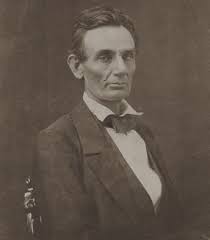
If ever a great leader had reason for mental illness it would have been Lincoln. Any child who experiences the trauma of the loss of a parent at a young age is bound to have difficulty in coping with loss. Lincoln was fortunate when after his mother Nancy’s death, his father rekindled a relationship with Sarah Bush Johnston. She soon became not only his step-mother, but also his best friend. Lincoln’s difficulites were not so much the result of losing his mother, but the difficult relationship he had with his father Thomas who insisted Lincoln work rather than get an education during his teenage and young adult years.
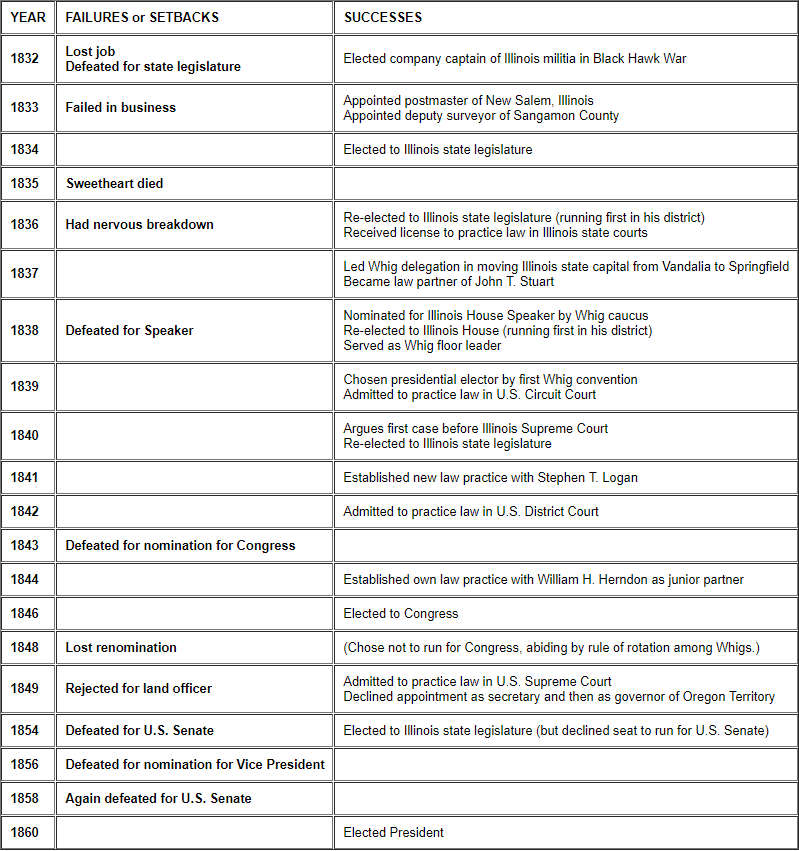
Grief, loss, marital difficulties, the death of children all added to Lincoln’s “Melancholy.” What is important for us to know isn’t the fact that Lincoln struggled with Depression as more than 1 in 5 Americans do today. What’s important to learn from Lincoln is the fact that he used his depression to motivate him. Though it is “mental illness”, this illness was his obstacle, his challenge, and it was this difficulty that fueled his desire to overcome.
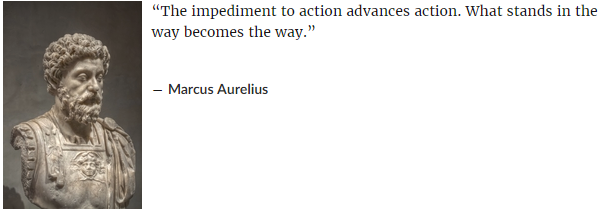
Whether Lincoln’s approach to dealing with setbacks was fueled by his understanding of the classics, or whether he stumbled from one crisis to another as these crises presented themselves to him, it is clear that Lincoln resolved to overcome the challenges they presented by his force of will. If one struggles through enough crises it would appear that like anything else, they become better at it. Rebounding from setbacks, failures, and disappointments was one of Lincoln’s greatest skills.

The dichotomy we are faced with today is having leaders who have a proven record of success versus having leaders who have experienced loss and failure. The people who win the awards, who are offered the contracts, and who are believed to be the most successful are often the ones chosen for more awards, better jobs, and promotions. Being good at “failing” isn’t something anyone wants to be good at. We all want to be good at being good. Life doesn’t always work that way though. The allure of success, beauty and intelligence is appealing, but I submit that there’s another way we should look at things.
If Rocky Balboa were born in a two-parent home in a suburban neighborhood and was 6’4″ 235 lbs with an 82″ reach there would never have been any Rocky movies. This character is the epitome of the underdog and that’s what made these movies so popular for Americans and people around the world. We love the underdogs: Mr. Smith Goes to Washington, Seabiscuit, the 1980 U.S. Men’s Olympic Hockey Team, and the Bad News Bears are all iconic (and American) underdogs. Nobody ever “rooted” for the villanous opponents. We always cheered on the underdogs. Lincoln, like Balboa, wasn’t supposed to be the President of the United States nor was Balboa to become the World Heavyweight Champion. Neither Balboa nor Lincoln accepted the fact that some thought they were losers and so they became losers. They didn’t quit, they kept moving forward.
Though Abraham Lincoln is thought of as modest, and regularly made fun of himself through his self-deprecating sense of humor, he was extremely ambitious. He wanted to lead and though the failures were setbacks, he refused to let those setbacks define him. That’s why we like him so much.
So the lesson to those of us who have experienced loss, failure, and setbacks isn’t that we’re relegated to a second-rate life because of those experiences. In fact, the setbacks have made us better, stronger, faster. Lincoln’s tragic death is made even more tragic by the fact that less than a week before his death General U.S. Grant received the unconditional surrender from Robert E. Lee on April 9, 1865 at Appomattox Courthouse in Virginia. The victory had been won! What Lincoln would want his countrymen to learn from his example is to never give up and to keep moving forward – that’s how winning is done!

 Saxton's Educational Musings