February 2
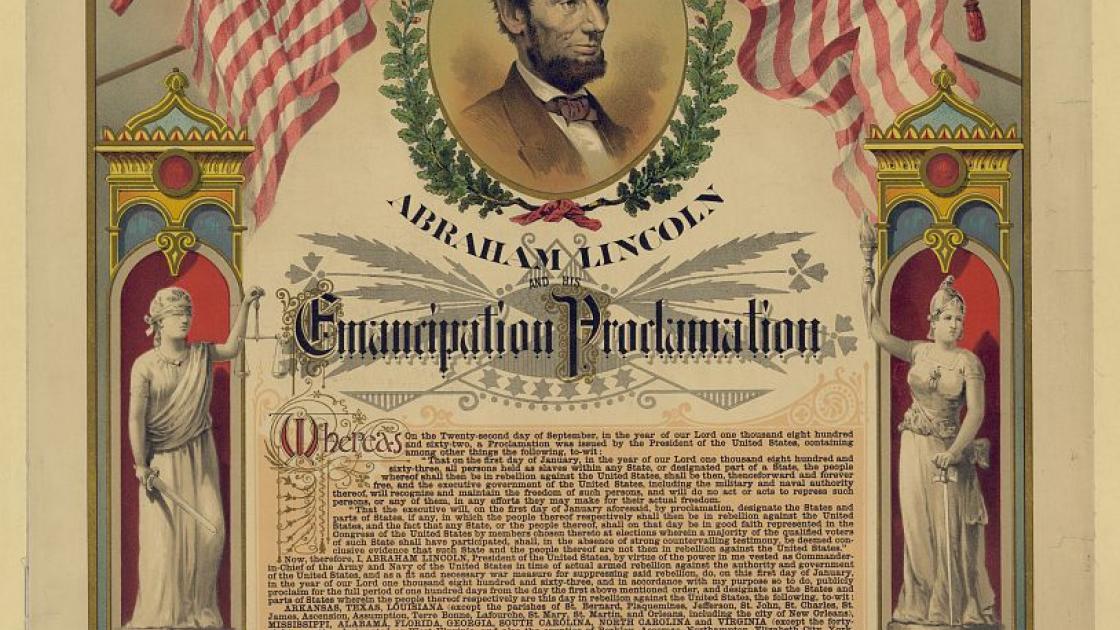
“I do order and declare that all persons held as Slaves within said designated states and parts of states are and henceforward shall be free.”President Abraham Lincoln, September 22, 1863
Although the “12 Days of Lincoln” aren’t necessarily in order of importance, there is no doubt that Lincoln’s proclamation to free the slaves in the southern states is among the most important acts of his presidency and one of the most important documents in U.S. History. The proclamation was significant for a variety of reasons which include political, military, diplomatic, and morally important reasons.
Ironically the Emancipation Proclamation freed virtually no one. Since the south had seceded, and the proclamation only freed slaves in the states in rebellion its impact was actually pretty limited. But the statement that this act made was hugely important. By issuing the document Lincoln was establishing the fact that the slaves were freed even before a constitutional amendment prohibited slavery, it thwarted the efforts the south may have used to conscript slaves into the confederate army, and it sent a message to Great Britain and France, which combined with victorious battles during the mid to late summer of 1863 prevented those superpowers from entering the war on the side of the CSA. Even more importantly Lincoln was making a moral statement as the first President to issue a formal executive document prohibiting slavery regardless of its area of designation.
In today’s world, revisionist history has clouded our knowledge and understanding of the moral positions of many of our past leaders. Some former leaders are judged more harshly than others and I am often troubled by judgements made by contemporary persons of the lives of some of these leaders. It’s difficult to reduce an individual to simply”good” or “bad” based on some of what we know about these people without the benefit of having lived at the same time. It may not be totally fair to judge leaders such as Benjamin Franklin, George Washington, and Thomas Jefferson based on some of what has recently been revealed about some of their personal affairs. Likewise, it may also not be completely fair to judge some of our more modern leaders based on what we know about their personal lives as is the case with Franklin Roosevelt, John F. Kennedy, or Martin Luther King Jr. The fact is even these leaders, just like us, have failed at times and made a number of mistakes based on challenges they were facing at the time. Some have alleged that while Lincoln believed in the idea of freedom for the slaves, he was still a racist. Sometimes the lack of empirical evidence of these stories is regarded as truth even without proof. There is, however, ample evidence to prove that Lincoln’s beliefs were evolving throughout the war, and that he was deeply moved and changed by his experiences as a wartime President. Unfortunately after the unprecedented progress made by Lincoln in the 1860s there was very little activity by subsequent American Presidents to continue to advance the cause of Civil Rights throughout the next 100 years after the war’s end.

 Saxton's Educational Musings